Product Description
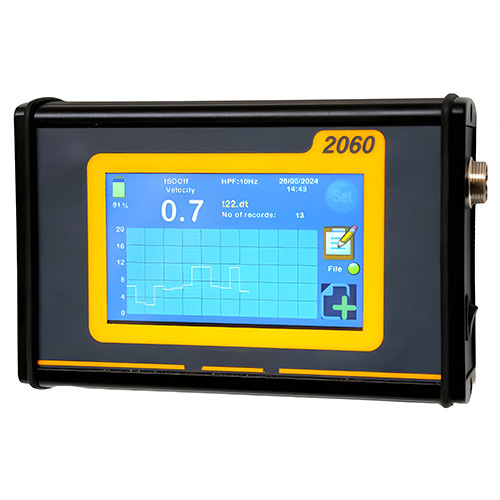
The 2060 is a data-logging vibration measurement instrument equipped with ample memory for storing historical vibration data for each measurement point. Designed for simplicity and effectiveness, it is an invaluable tool for detecting rising vibration trends and supporting condition monitoring programs. Each time a measurement is taken, the instrument displays a graphical trend of past readings for the selected machine and point.
Features
- Vibration measurement with historical data storage in a compact, handheld unit
- True RMS measurements compliant with IS 11724 (ISO 2372), including overall vibration levels; readings can be color-coded according to ISO severity classes
- Multi-mode capability: True RMS vibration velocity, bearing spike, and peak-to-peak displacement
- 4.3" color graphic LCD with touch control
- Data transfer to PC via RS232-to-USB bridge
Applications
- Mechanical defects in machinery generate vibrations where the magnitude correlates with severity and the frequency corresponds to the source of the defect. Issues such as unbalance, misalignment, worn bearings or gears, and belt problems typically fall within the IS-specified frequency band of 10 Hz-1 kHz, each contributing to vibrations at strategically selected points on the machine.
- Under normal conditions, each machine maintains a stable vibration signature. As defects develop, vibration levels show a rising trend. Further diagnosis through vibration analysis (possible with advanced instruments such as the 6090) can pinpoint the exact nature of the fault.
- The 2060 allows users to create a file for each measurement point, storing all time-stamped vibration values along with relevant settings. Whenever a file is opened, the instrument displays a graph of magnitude versus reading number, showing the trend clearly.
- This enables easy implementation of a plant-wide, route-based vibration monitoring program. File names can be configured intelligently to reflect route order. Data can be systematically collected, recorded, and transferred to a PC using standard tools such as Excel or any common serial terminal software, forming a robust long-term database for each point.
- The instrument can also be used in production environments for quality control, logging each measurement with a time stamp under a user-defined file name.
- With 16 GB of storage, the unit provides virtually unlimited measurement capacity.







 Send Inquiry

